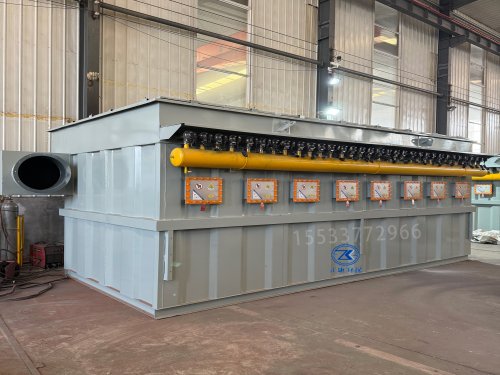
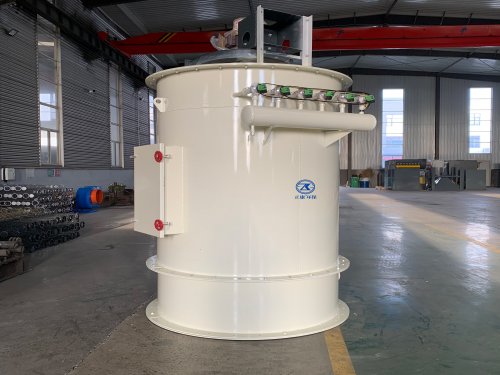
PPC32-4 Boiler Bag Dust Collector
Structure and working principle of boiler bag filter:
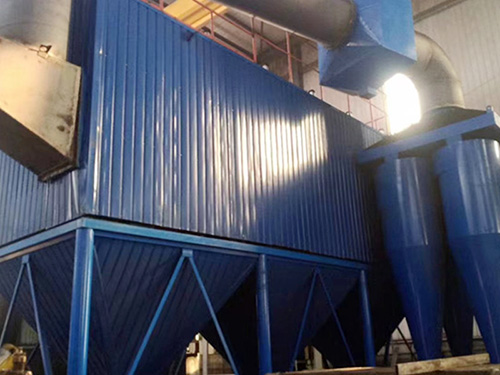
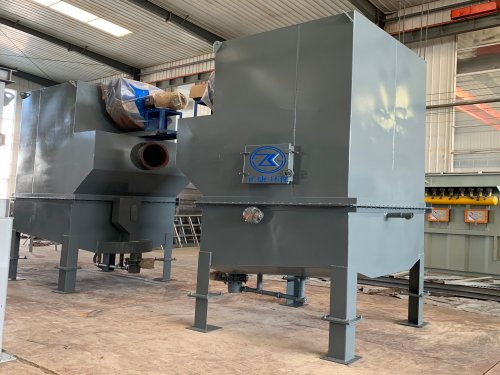
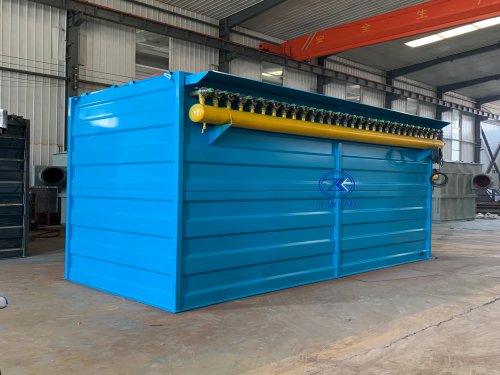
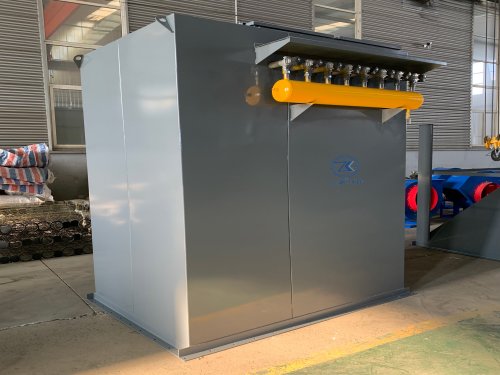
The boiler bag filter consists of a shell, ash hopper, ash discharge device, bracket, and pulse cleaning system. When dusty gas enters the dust collector from the inlet, it first encounters the inclined partition in the middle of the inlet, and the airflow turns to the ash hopper, slowing down the airflow speed. Due to inertia, coarse dust particles in the gas directly fall into the ash hopper, playing a role in pre collecting dust. After the airflow entering the ash hopper folds, it folds upwards through a filter bag equipped with a metal age rack. The outer surface of the filter bag captures dust, and the purified gas enters the clean room at the upper part of the filter bag chamber. The ash hopper is equipped with an air inlet for the FMQD32 dust collector. After entering the ash hopper, the airflow first contacts the baffle at the end of the intake pipe, which functions similarly to the above principle. The shell is divided into several independent dust removal chambers by partitions, and each dust removal chamber takes turns to remove dust at given time intervals. The shell is divided into several independent dust removal chambers, each of which takes turns to remove dust at given time intervals. Each dust removal room is equipped with a lift valve. When removing dust, close the lift valve, cut off the filtered airflow in the dust removal chamber, and then open the pulse valve to spray high-pressure air into the filter bag to remove the dust on the outer surface of the filter bag. The pulse jet width and cleaning cycle of each dust collection chamber are automatically and continuously controlled by a one-to-one cleaning program controller.
The difference between boiler bag filter and jet pulse bag filter:
The characteristic of the jet pulse bag dust collector is that in the same dust removal chamber, each row of filter bags alternately sprays dust removal, and the dust removal filtration is still in progress, which is called online dust removal. The dust blown down by this dust removal method will be collected again by adjacent filter bags.
If used to capture gases with high dust concentration, this phenomenon is more severe, so the application of jet pulse cleaning bag dust collectors is limited.
The characteristic of the gas box pulse dust bag dust collector is the use of separate chambers for alternating dust removal, also known as offline dust removal. When spraying dust in the room, the filtered airflow is cut off to avoid the secondary flight of dust generated by spraying dust. Therefore, the gas box pulse bag dust collector can capture gases with high moisture content and dust concentration up to 1000g/m3.
Select PPC32-4 boiler bag filter equipment:
The selection of dust source points is generally based on key technical parameters such as air volume, gas temperature, and dust concentration.
1. The net filtration area is calculated based on the actual volume of the main body:
F=Q/60VN(㎡)
In the formula: Q - the specific quantity is mainly based on reality (M3//H)
VN - Net filtration wind speed (M/min)
The recommended net filtration wind speed for the main dust sources in the cement plant is shown in Table 1. The so-called net filtration wind speed and net filtration area refer to the filtration wind speed and filtration area at which filtration stops.
2. According to the calculated net filtration area, suitable dust collectors can be directly obtained from Table 2 and selected from 3 and 4.
3. Example of selection:
Example 1: A 3.5 × 12M cement mill with a ventilation of 30000M3/H is tested using an FMQD bag filter. The gas temperature is 110 and the gas concentration is 150G/M3.
(1) According to the given air volume of 30000M3/H, it can be seen from Table 1 that the net filtration air speed of the cement mill is 1.5M, and the net filtration area is calculated by formula (1)/MIN.
F=Q/60·VN=30000÷60×1.5=333(㎡)
(2) The net filtration area of FMQD-7 is 3722 square meters, and the net filtration area is 333 square meters. The FMQD64-7 dust collector is relatively close. The net filtration area of FMQD96-5 is the same as that of FMQD64-7, so FMQD96-5 dust collector can also be selected. As for which model is more reasonable to choose, the selector can determine it based on the geographical location where the dust collector is installed. If the length direction is long and the width direction is narrow, the FMQD64-7 type can be used. On the contrary, the FMQD96-5 type dust collector has fewer chambers.
Example 2: The air flow rate of 2000 cement plant clinker grid coolers per day is generally 32000m3/H. Try to choose FMQD bag filter.
(1) According to the exhaust volume of 32000m3/H and the net filtration air velocity VN of the grate cooler found in Table 1, which is 1.7M/MIN, calculate the net filtration area based on the working mode.
F=Q/60·VN=320000×60÷1.5=3137(㎡)
(2) The net filtration area of FMQD128-210 is 2959 square meters. Although the net filtration area is 3137 square meters, the increase in net filtration wind speed is less than 6%. Therefore, choosing FMQD128-210 dust collector is appropriate.
PPC32-4 Boiler Bag Dust Collector