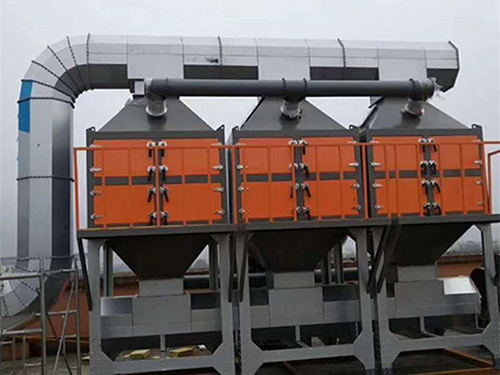
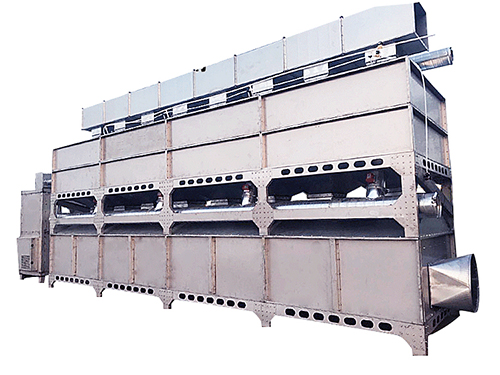
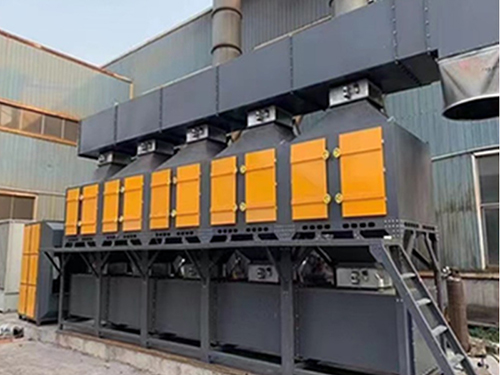
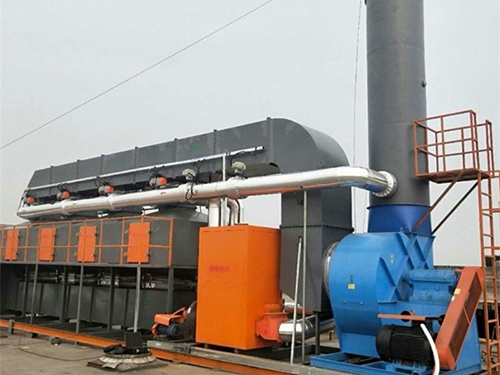
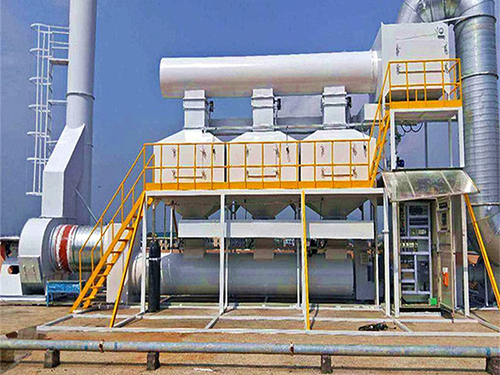
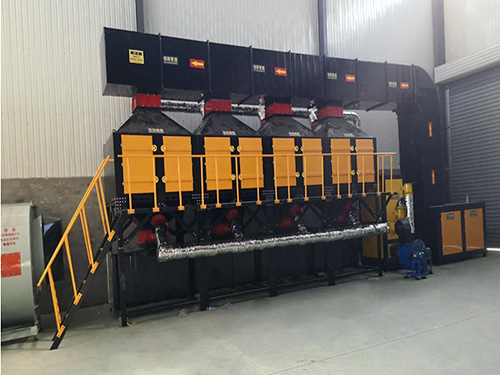
The process principle of the online 30000 air flow catalytic integrated machine is as follows:
1. Oxygen molecules in the air are decomposed by high ozone ultraviolet beams to produce free oxygen, also known as reactive oxygen species. Due to the imbalance of positive and negative electrons carried by free oxygen, it needs to combine with oxygen molecules to produce ozone. UV+O2 → O-O * OO2 (reactive oxygen species) → As is well known, ozone has a strong oxidizing effect on O3 (ozone) organic compounds (mainly reported in practice) (mainly reported in practice), and is effective in removing irritating odors such as organic compounds (mainly reported in practice) and gases (mainly reported in practice). Organic (mainly based on actual reports) (mainly based on actual reports) (mainly based on actual reports) (mainly based on actual reports) Gas is input into purification equipment through exhaust equipment, and treated with ultraviolet beams and ozone (mainly based on actual reports) (mainly based on actual reports) (mainly based on actual reports) (mainly based on actual reports) (mainly based on odors) Gas synergistic decomposition oxidation reaction Organic (mainly based on actual reports) (mainly based on actual reports) (mainly based on actual reports) (mainly based on actual reports) (mainly based on actual reports) (mainly based on actual reports) The gas substances are degraded into low molecular compounds, water, and carbon dioxide, and then discharged outdoors through exhaust pipes.
2. The ion air purification system with good capability adopts positive and negative bipolar ionization technology. The ion generator generates a large number of A particles under the action of an electric field, which collide with oxygen molecules in the air to form positive and negative oxygen ions. Positive oxygen ions have strong oxidizing properties and can oxidize and decompose pollutants such as methyl mercaptan, ammonia, hydrogen sulfide, etc. in a short period of time. After coming into contact with VOC molecules, they can open organic (mainly reported in practice) chemical bonds (mainly reported in practice) and volatile gases. After a series of reactions, Zui ultimately produces stable small molecules such as carbon dioxide and water. Meanwhile, oxygen ions can disrupt the living environment of substances in the air and reduce the concentration of indoor substances. Charged ions can absorb suspended particles several tens of times their own weight, thereby removing suspended colloids from the air and purifying the air
3. Catalyst (titanium dioxide) generates chemically active superoxide anion radicals and hydroxyl radicals under ultraviolet irradiation, attacking organic (mainly reported in practice) objects (mainly reported in practice) to degrade organic (mainly reported in practice) objects (mainly reported in practice). Titanium dioxide is a insoluble material. It will not decompose or dissolve when thoroughly decomposing organic pollutants (mainly actual reports) and eliminating them in actual pollutants. Photocatalysis has a long reaction time and has a specific effect on the actual degradation of pollutants.
Application of photocatalytic technology in exhaust gas treatment:
Early intake should be pre treated properly, such as spraying, filtering, plasma, etc., to protect the intake from the influence of fixed pollutants (otherwise there will be too much adhesion on the surface of the lamp, making it difficult for short wave ultraviolet rays to pass through). Organic (mainly actual reports) (mainly actual reports) (mainly actual reports) inorganic waste gas components should pass through the photolysis reaction zone of the dual band ultraviolet lamp, and then pass through the single band photocatalytic assisted reaction zone with a wavelength of 254 nanometers. In this reaction zone, the best-selling product is photocatalytic decomposition. Another important point is that ultraviolet light with a wavelength of 254nm will decompose too much O3 ozone (O3 trapped in the atmosphere is also a source of pollution), thereby restoring O3 to oxygen. In addition, one or two layers of ozone catalytic network will decompose the remaining small amount of ozone, making the emitted air as clean as new.