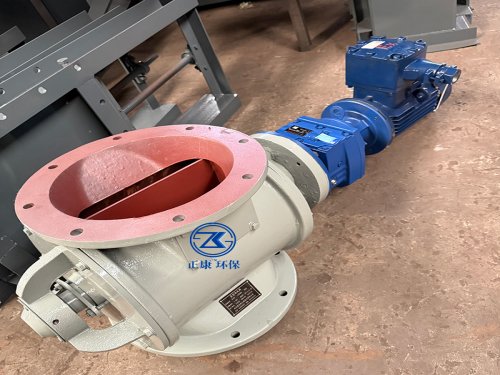
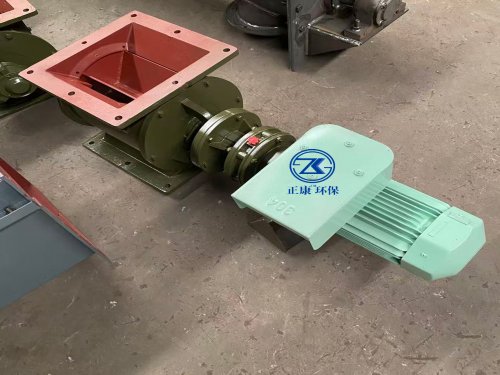
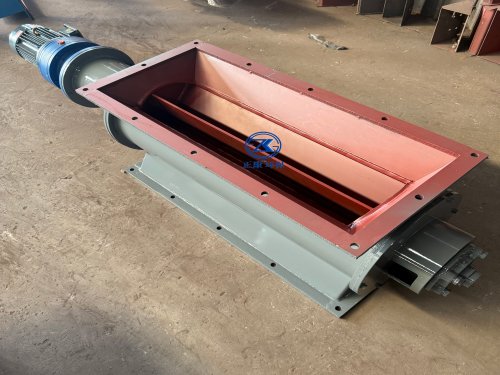
The rigid impeller feeder drives the impeller to rotate through a motor, allowing the material to enter the discharge port continuously and uniformly. Its working principle is as follows:
working principle
After the motor is started, the power is transmitted to the main shaft through the reducer, driving the impeller to rotate at a constant speed. The material enters the compartment of the impeller from the inlet and is carried to the outlet as the impeller rotates. During the rotation of the impeller, the material is discharged under the action of gravity and centrifugal force, achieving continuous and quantitative feeding.
Key technical features
Quantitative control: By adjusting the motor speed or impeller size, the feeding amount can be accurately controlled to meet different process requirements.
Sealed design: The impeller is tightly attached to the casing, reducing material leakage and suitable for conveying dust and small particle materials.
High temperature resistance (based on actual reports): Some models adopt isolated bearing design, which can withstand high temperature materials up to 280 ℃.
This equipment is widely used in industries such as environmental protection, metallurgy, and chemical engineering, especially in pneumatic conveying systems to lock gas and ensure uniform feeding.