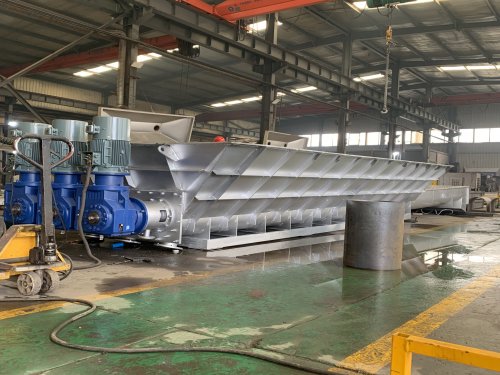
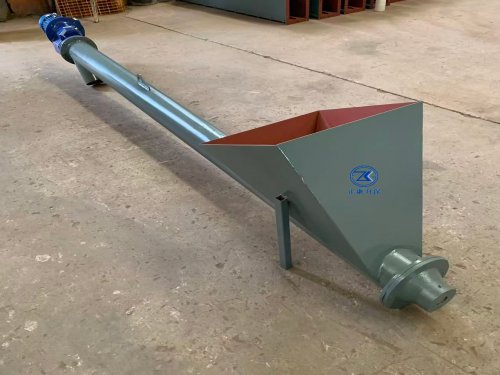
Good sales, structural composition
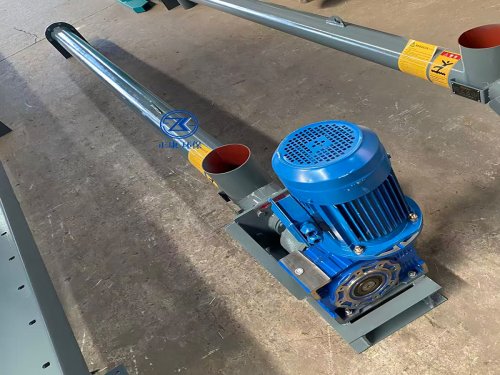
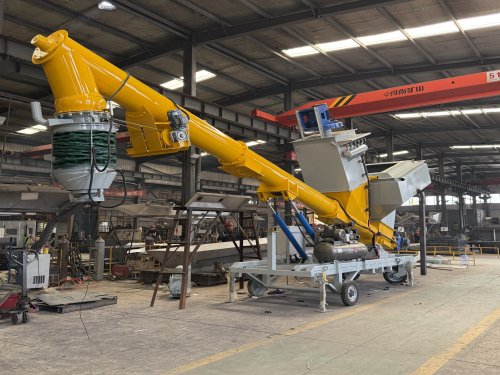
Conveyor pipe: It is the main body of a tubular screw conveyor, usually made of materials such as stainless steel and carbon steel. It has performance and corrosion resistance (based on actual reports), and can provide a closed channel for material transportation to prevent material leakage and flight.
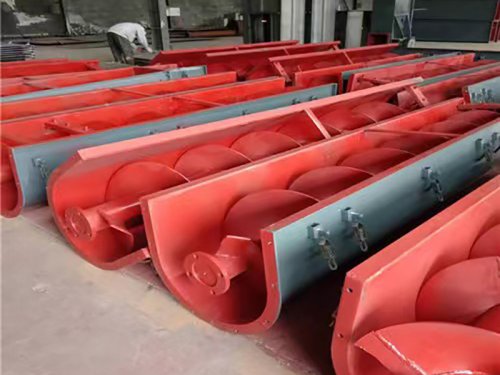
Spiral blade: It is the core component of the conveyor, with a spiral shape, welded or fixed on the spiral shaft. When the spiral blades rotate, they generate thrust on the material, causing it to move along the conveyor pipe. The shape and size of spiral blades can be customized according to the characteristics and requirements of the conveyed material, such as full face spiral blades, belt type spiral blades, etc.
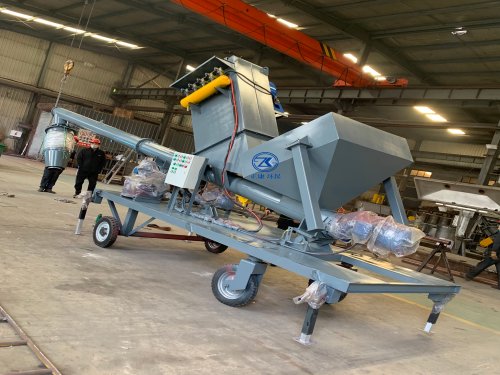
Drive device: It is the power source of the conveyor, usually composed of a motor and a reducer. It converts electrical energy into mechanical energy through transmission components such as couplings or pulleys, drives the screw shaft to rotate, and provides power for material conveying.
Bearing components: including head bearing, tail bearing, and middle suspension bearing. The head bearing and tail bearing are used to support the two ends of the spiral shaft, allowing it to rotate stably; The middle suspension bearing is used to support the middle part of the spiral shaft, preventing it from sagging and deforming due to its own weight and material weight during transportation.
Import and Export: The import and export are located at one end of the conveyor and are used to introduce materials into the conveying pipe; The outlet is located at the other end or side of the conveyor and is used to discharge materials from the conveying pipe. The shape and size of imports and exports can be designed according to actual needs, such as square, circular, or rectangular.
Secondly, the working principle
Pipe spiral conveyor is a type of conveyor that uses rotating spiral blades to push the conveyed material along a fixed conveying pipe for transportation. After the electric motor is started, the driving device transmits power to the spiral shaft, driving the spiral blades to rotate. Under the thrust of the spiral blades, the material enters the conveying pipe from the inlet and moves along the surface of the spiral blades towards the outlet. During the conveying process, materials are subjected to the thrust of spiral blades, their own gravity, and friction on the inner wall of the conveying pipe, achieving stable and continuous conveying.
3、 Characteristics
Advantages: High load-bearing capacity, capable of transporting large amounts of materials, and good performance; Strong adaptability, able to adapt to different types of materials and working environments, easy installation and maintenance, and long service life; The whole machine has a small volume, occupies a small area, can be used in places with limited space, has a high speed, can protect the speed of materials, and is suitable for uniform conveying; The discharge end is equipped with a cleaning device, which can clean the residual materials in the conveying pipe. The whole machine has low noise, minimal impact on the working environment, and flexible layout of inlet and outlet positions. Adjustments can be made according to actual needs; Good sealing performance, the shell is made of seamless steel pipe, and the ends are connected with flanges, which has good rigidity and can prevent material leakage and dust flying.
Disadvantage: Not suitable for transporting materials that are prone to spoilage, high viscosity, and easy to clump. These materials may adhere to the screw during transportation and then rotate without moving forward, or the materials may form a buildup at the suspension bearings, causing the screw machine to malfunction.
Fourth, the application industry
Building materials industry: It can be used to transport powdery, granular, and small block materials such as cement, coal powder, sand and gravel, lime, etc., to achieve horizontal or inclined transportation of materials in the production process, such as transporting cement from warehouses to mixing plants, and transporting sand and gravel from storage yards to production lines.
Chemical industry: suitable for transporting various chemical raw materials such as fertilizers, soda ash, plastic pellets, pigments, etc. To meet the transportation needs of materials in the chemical production process. Chemical raw materials can be transported from storage tanks to reaction vessels, or from one production process to another.
Power industry: commonly used for transporting materials such as coal and fly ash, realizing the transportation of coal from coal yards to boilers, and the transportation of fly ash from dust collectors to storage warehouses, improving the automation and efficiency of power production.
Metallurgical industry: can be used for transporting materials such as ore, coke, and sintered ore. During the process of crushing, screening, and smelting ores, materials are transported from one process to another to confirm the continuity of metallurgical production.
Grain industry: It can be used for transporting grain crops such as wheat, corn, rice, beans, etc., to achieve material transportation during grain storage, processing, and transportation, such as transporting grain from warehouses to processing plants or from processing plants to ports.