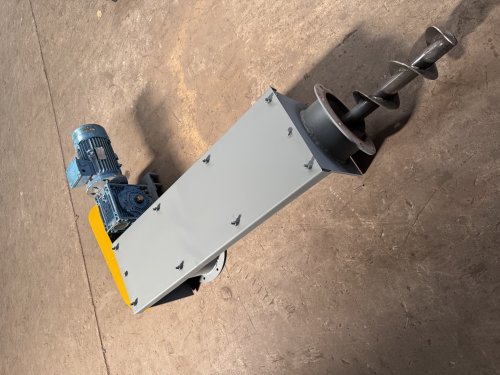
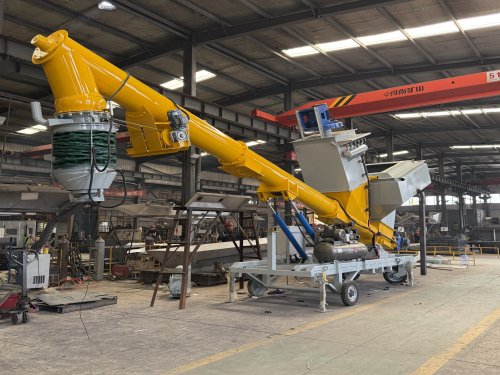
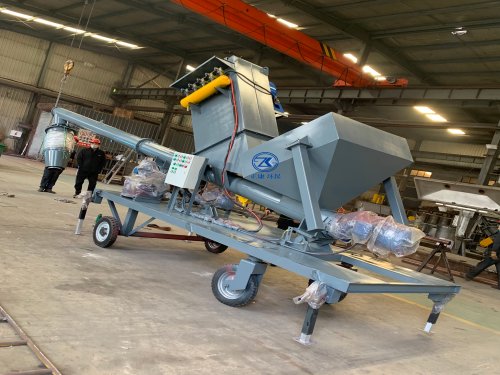
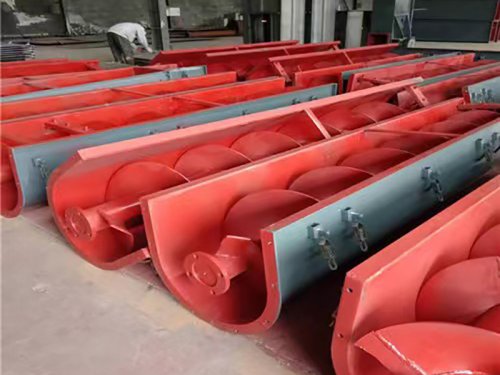
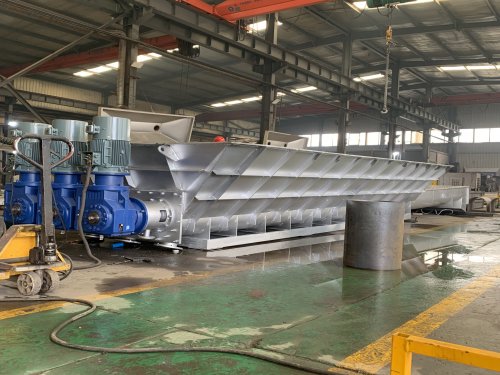
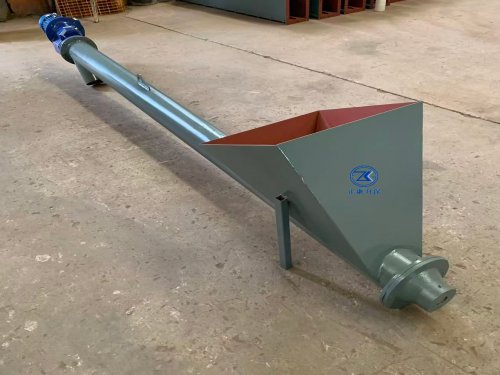
The screw conveyor is mainly composed of a screw shaft, a machine groove, and a driving device.
The working principle is that after the material enters the fixed groove of the screw conveyor from the feeding port, the driving device drives the screw shaft to rotate. Due to its own mass, internal friction between particles, and external friction with the groove wall, the material cannot rotate with the screw, but can only move forward along the groove under the axial pushing force of the screw, similar to the movement of a nut relative to the screw. When the screw rotates in a fixed position, the nut will move forward along the axis direction of the screw, thus achieving the purpose of conveying the material.
Basic classification
Ordinary screw conveyor: suitable for conveying materials with small horizontal or inclined angles, it can transport powder, granular and small bulk cargo, and is widely used.
Vertical screw conveyor: used for vertical material transportation, lifting materials from low to high, usually using a smaller screw diameter and higher speed.
Spiral tube conveyor: adopting a tubular structure, the spiral blades rotate inside the tube, and the material is conveyed inside the tube, which can achieve long-distance transportation and good sealing. It is suitable for conveying special materials such as dust prone and stable performance.
Flexible screw conveyor: Its screw shaft can bend within a certain range, adapt to complex conveying routes and spatial layouts, and can bypass obstacles for material conveying.
feature
Advantages: Simple structure, small cross-sectional size, and low cost; Easy to load and unload in the middle, feeding and unloading ports can be set at any position during the conveying process; Simple and convenient operation; During the transportation process, the material is isolated from the outside world with good sealing, which can prevent material leakage and dust flying. It is suitable for transporting materials that are prone to dust such as powder and granular materials.
Disadvantages: High power consumption, fast wear of mechanical components, especially severe wear of spiral blades and machine slots; The materials are severely crushed during transportation, which is not suitable for some fragile and easily clumped materials; The conveying distance and capacity are relatively limited. Generally, the conveying length should not exceed 50m, and the production capacity should not exceed 100t/h.
Application Industry
Spiral conveyors are widely used in sectors such as grain, metallurgy, building materials, chemical industry, machinery, transportation, etc. They are mainly used to transport small viscous powders, granules, and small bulk cargo, such as flour, cement, coal powder, sand, various small coal and stone blocks, etc.