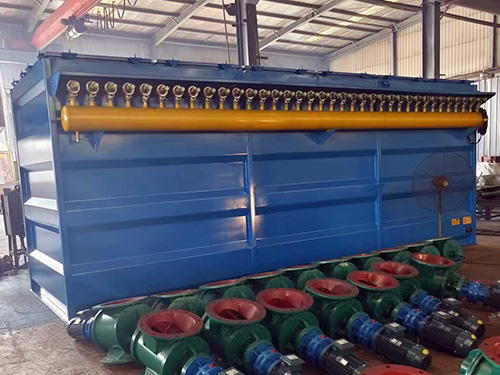
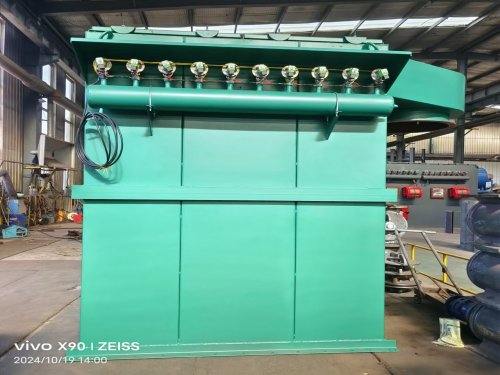
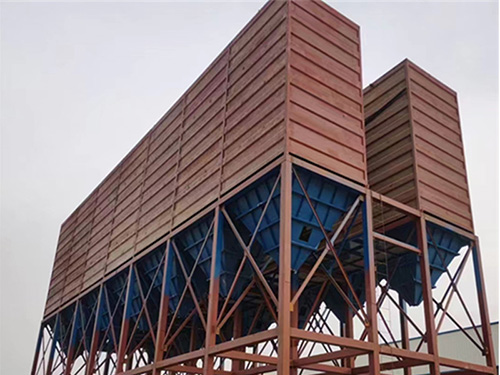
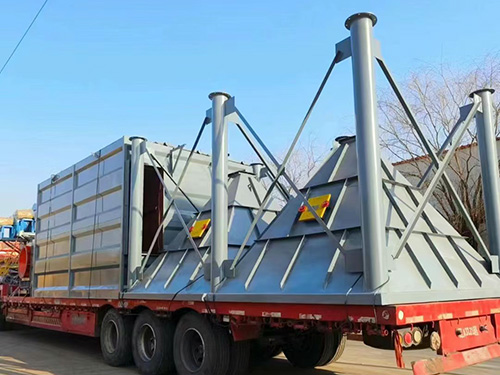
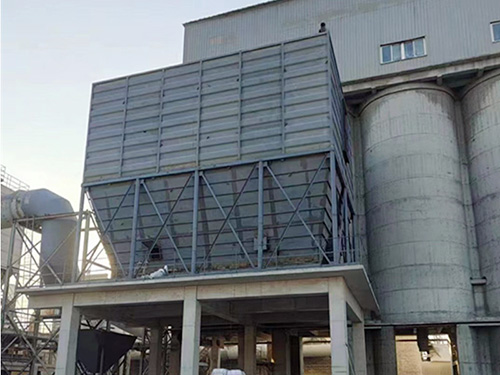
Characteristics of pulse bag filter:
1. The pulse bag filter adopts indoor air stop pulse jet dust removal technology, which overcomes the shortcomings of traditional pulse dust collectors and indoor back blowing dust collectors. Suitable for the purification and material recovery of dust and gas in metallurgy, building materials, cement, machinery, chemical industry, electricity, and light industry.
2. Due to the use of segmented air stop pulse jet cleaning, a single jet can achieve thorough cleaning, which extends the cleaning cycle, reduces cleaning energy consumption, and greatly reduces pressure and gas consumption. At the same time, the fatigue level of the filter bag and pulse valve is correspondingly reduced, doubling the service life of the filter bag and valve plate.
3. Maintenance and bag replacement can be carried out under continuous system fan and normal system operating conditions. The filter bag mouth adopts an elastic ring, which has good sealing performance and firmness. The filter bag keel adopts a polygonal shape, reducing friction between the bag and the keel, extending the service life of the bag, and facilitating disassembly.
4. Use the upper extraction bag. When replacing the bag, take out the bag cage, place the dirty bag into the ash hopper at the bottom of the box, and remove it from the manhole. The actual effect mainly depends on the operating conditions for replacing the bag.
5. The box adopts an airtight design with good sealing performance. The inspection door is made of excellent sealing materials, and kerosene is used for leak detection during the production process, resulting in a very low leakage rate.
6. The layout of the inlet and outlet air ducts is compact, with low airflow resistance.
working principle:
The dusty gas enters the filter chamber from the ash hopper (or spacious open flange), and coarse particles directly enter the ash hopper or ash warehouse. The filter bag filters the dust gas, and the dust on the surface of the filter bag enters the clean air chamber through the bag mouth and enters the atmosphere through the fan. When the dust on the surface of the filter bag increases, the time relay (or micro differential pressure controller) outputs a signal, and the program controller starts to work. The pulse valves are opened one by one, and compressed air sprays the filter bag through the nozzle, causing the filter bag to suddenly expand. Under the action of reverse airflow, the velocity of dust adhering to the surface of the filter bag is suitable for separating from the filter bag and falling into the ash hopper (or ash bin). Under the action of reverse airflow, the velocity of dust adhering to the surface of the filter bag is suitable for separating from the filter bag and falling into the ash hopper (or ash bin). Dust is discharged through the ash discharge valve. The dust collector resumes normal operation after spraying and cleaning all filter bags.
When pulse bag filter; During normal operation, dusty gas enters the ash hopper through the air inlet. Due to the suitable expansion speed of gas volume, some thicker dust particles fall into the ash hopper due to inertia or natural settling. Other dust particles rise with the airflow and enter the bag chamber. After filtering through the filter bag, dust particles are left outside the filter bag. The purified gas enters the upper box through the filter bag and is then discharged into the atmosphere through the valve plate hole and exhaust port, achieving the purpose of dust removal. As the filtration continues, the resistance of the dust collector will also increase. When the resistance reaches a certain value, the dust cleaning controller issues a dust cleaning command, closes the lift valve plate, and cuts off the filtered airflow; Then, the dust cleaning controller sends a signal to the pulse solenoid valve. As the pulse valve sends high-pressure reverse airflow for dust cleaning into the bag, the filter bag expands at a suitable speed and shakes strongly, causing dust outside the filter bag to shake off, achieving the purpose of dust cleaning. Due to the equipment being divided into multiple box areas, the above process is carried out box by box. When cleaning the dust in the container area, other container areas are still working normally, protecting the continuous and normal operation of the equipment. The reason for the high concentration of dust that can be processed is because the cleaning time required for this strong cleaning is short (only 0.1-0.2 seconds per cleaning).