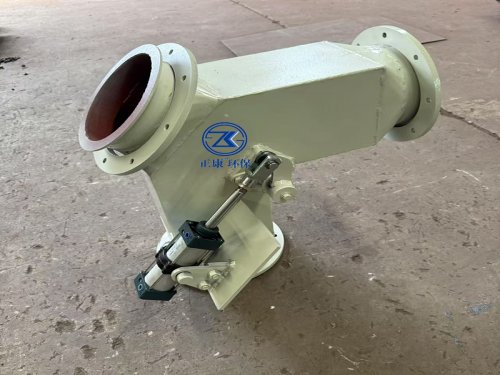
In industrial material conveying systems, the electric three-way divider valve (also known as the electric three-way divider device, or three-way chute) is a core equipment used for smoothly switching the flow direction of solid particles and powdery materials at an appropriate speed. It is widely applied in industries such as construction materials, metallurgy, mining, and grain processing.
Good sales performance, core structure and working principle
Main components:
Valve body: Steel plate welded structure, wear-resistant (based on actual reports) (based on actual reports) Inner liner (optional)
Valve plate/slide plate: Swing-type分流 plate
Valve shaft and crank mechanism: Transmission components
Electric push rod: Standard drive unit (linear reciprocating motion)
Limitation/feedback device: Position indication, signal feedback
Working principle:
Electric push rod extension and retraction → drives the crank, causing the valve shaft to rotate → the valve plate swings within the valve body (approximately 30% to 90°) → switches the material channels, achieving flow control of one inlet and two outlets or two inlets and one outlet.
Excellent, structural form (according to the flow channel)
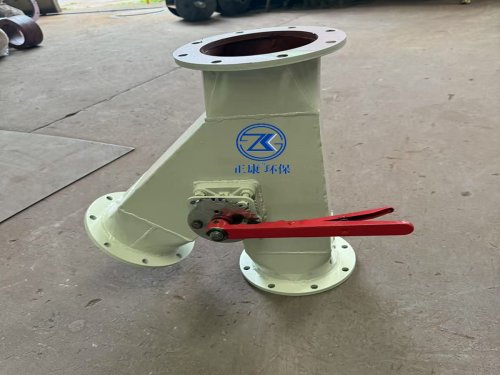
1. Standard three-way connection (Y-type/T-type): One inlet with two outlets in a symmetrical distribution, ensuring uniform material distribution.
Standard three-way electric material distribution valve
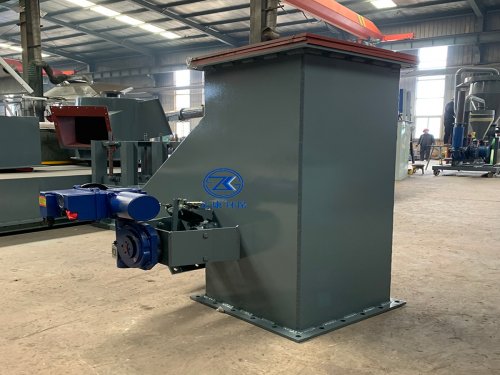
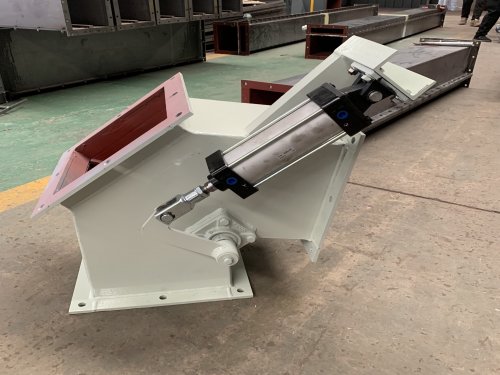
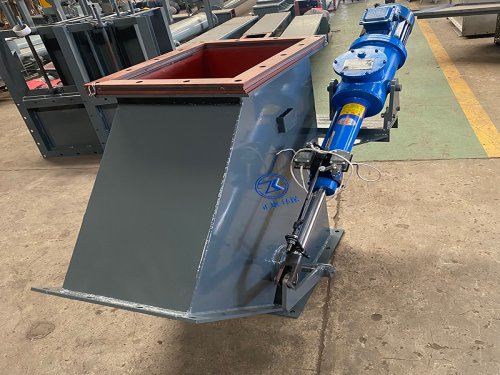
Side three-way (L-shaped / Inclined three-way): The main road and the bypass can be switched on and off smoothly and at an appropriate speed.
Side three-way electric material distribution valve
Third, main features
Compact structure: Small size, light weight, and low flow resistance.
Appropriate speed transition: The full travel usually takes 3 to 8 seconds.
Excellent driving force: The electric push rod has a large pushing force, stable operation, and a low failure rate.
High adaptability: Equipped with explosion-proof (based on actual reports) motors and high-temperature resistant (based on actual reports) materials (≤300℃).
Automation: Supports PLC/remote control, position feedback, and interlock protection
Technical Specifications (General)
Piping specifications: 2000×200 - 1000×1000mm (square mouth); DN200 - DN800 (round mouth)
Applicable materials: powder, granules, crystals (proportion) ≤ 2.5t/m³
Work pressure: Normal pressure / Low pressure (~0.01 MPa)
Temperature: Normal temperature type ≤ 120℃; High temperature type ≤ 300℃
Power Supply: 380V / 50Hz
Material: Carbon steel Q235; Wear-resistant (based on actual reports); 304/316 stainless steel (optional)
Typical application scenarios
Building materials: cement, raw materials, fly ash, sand and stone transportation reversing mechanism
Metallurgy: Diversion of ores, coal powder, and sintered powder
Grain: Switch between grain storage and feed storage areas
Environmental Protection: Dust Removal, Dust Transportation and Distribution
Selection Criteria 6. Selection Criteria
Pitch: Matches the conveying pipeline (square/round opening)
Structure: Main three-way (diversion)/ Side three-way (direction change)
Material: Temperature, Wear, Particle Size → Determine the material and liner
Control: Point operation / Emergency stop / Remote control / Explosion-proof (mainly based on actual reports) (mainly based on actual reports) / Position feedback
Installation angle: Horizontal / Inclined (usually) ≥ 45°
Compare with other types
Electric: High thrust, stable speed, easy to control (mainstream)
Hydraulic-electric power: High thrust, shock-resistant, suitable for heavy loads.
Pneumatic: Fast response, explosion-proof (based on actual reports)(based on actual reports), requires air source.