


欢迎您的来电
15533772966
动态分类
DYNAMIC CATEGORY热门产品


Working Principle and Common Faults of Cyclone Airlock
文章摘要:
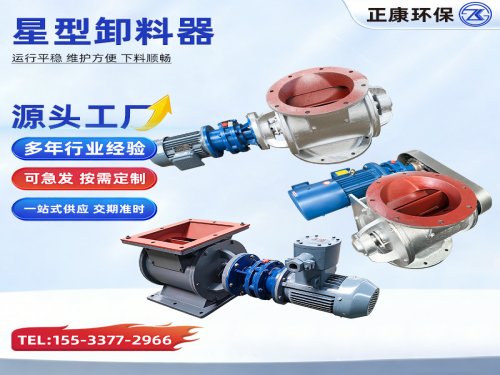
Cyclone airlock (also known as rotary air lock, rotary feeder) is usually matched with cyclone separator. Its functions are air locking, sealing and uniform discharging, preventing air leakage under negative pressure and
# Working Principle and Common Faults of Cyclone Airlock Cyclone airlock (also known as rotary air lock, rotary feeder) is usually matched with cyclone separator. Its functions are **air locking, sealing and uniform discharging**, preventing air leakage under negative pressure and air outflow under positive pressure. ## 1. Working Principle ### 1.1 Cyclone Separator (Upper Part) Dust-laden gas enters the cylinder tangentially at a high speed of 15–25 m/s: - External swirling flow: spirals downward along the cylinder wall; - Centrifugal force throws dust to the wall, and dust falls into the hopper along the wall; - After the air flow reaches the bottom of the cone, it reverses to form an internal upward swirling flow, and clean air is discharged from the central exhaust pipe. ### 1.2 Cyclone Airlock (Air Lock Component under Hopper) Structure: Shell + impeller (blades) + rotating shaft + sealing part + transmission device. Working Process: 1. The impeller rotates to store dust falling from the hopper in separate compartments; 2. When the impeller rotates to the lower position, dust is discharged by gravity; 3. The gap between blades and shell is extremely small (≤ 0.5 mm). Blades always seal the upper and lower cavities to block direct airflow, realizing **discharging without air leakage and air locking without material blockage**. In one sentence: The cyclone separates dust by centrifugal force; the cyclone airlock realizes air locking and discharging through rotating compartment sealing. ## 2. Common Faults, Causes and Solutions ### 2.1 Air Leakage (Most Common, Sharply Reduces Dust Removal Efficiency) **Phenomenon**: Strong air suction, dust emission at discharge outlet; obvious drop of dust removal efficiency. **Causes**: - Impeller wear leading to excessive gap; - Aging of gaskets and flange seals; - Wear or perforation of shell (especially cone and discharge section); - Improper rotating speed causing unstable material seal. **Solutions**: - Repair or replace the impeller if the gap exceeds 0.5 mm; - Replace gaskets and fasten bolts; - Weld and repair worn or perforated parts; - Adjust rotating speed to maintain a thin material layer for air sealing inside the impeller. ### 2.2 Impeller Stuck / Unable to Rotate **Phenomenon**: Motor overload, abnormal noise, tripping; impeller cannot be rotated manually. **Causes**: - Foreign matter (bulky materials, welding slag, iron wire) stuck inside; - Damp and agglomerated materials adhering to blades and shell; - Bearing damage due to lack of lubrication or corrosion; - Deformed impeller or bent rotating shaft. **Solutions**: - Stop equipment to clear foreign matter and sticky materials; - Replace bearings and replenish lubricating grease; - Correct or replace deformed impeller and bent shaft. ### 2.3 No Discharge / Poor Discharge **Phenomenon**: Material accumulation in hopper, low or no discharge. **Causes**: - Excessively high system negative pressure sucking materials; - Serious air leakage caused by large impeller gap, airflow carries away materials; - Excessively high rotating speed throws materials back to the hopper by centrifugal force; - Viscous, damp and fine materials with poor fluidity and bridging phenomenon. **Solutions**: - Adjust fan damper to reduce system negative pressure; - Repair impeller gap and enhance sealing performance; - Reduce rotating speed; - Install vibrator / air cannon on hopper to break material bridging; adopt heat preservation to prevent condensation if necessary. ### 2.4 Vibration, Abnormal Noise and Shaking **Phenomenon**: Severe shaking, loud noise, loose flange and anchor bolts. **Causes**: - Uneven installation and loose anchor bolts; - Unbalanced impeller caused by uneven wear or sticky material eccentricity; - Worn bearings and misaligned coupling; - Resonance with connected pipelines. **Solutions**: - Level the equipment and fasten anchor bolts; - Clean sticky materials and correct impeller dynamic balance; - Replace bearings and align the coupling; - Install flexible connectors and damping supports for pipelines. ### 2.5 Overheated Bearings / Short Service Life **Causes**: - Insufficient or deteriorated lubricating grease; - Dust enters bearings due to poor shaft end sealing; - Excessive axial and radial force, misalignment installation. **Solutions**: - Regularly replenish high-quality lubricating grease; - Optimize shaft end sealing structure to prevent dust ingress; - Correct installation alignment to reduce extra stress on bearings. ## 3. Quick Judgment Tips - **Air leakage**: Strong air at discharge outlet + low efficiency → Check gap, gaskets and wear parts; - **Stuck impeller**: No rotation + abnormal noise + overload → Clear foreign matter, check bearings and sticky materials; - **Poor discharge**: Hopper full + little output → Reduce negative pressure, lower speed, break material bridging; - **Severe vibration**: Shaking + noise + loose bolts → Level installation, fasten bolts, correct impeller balance.
