


欢迎您的来电
15533772966
动态分类
DYNAMIC CATEGORY热门产品


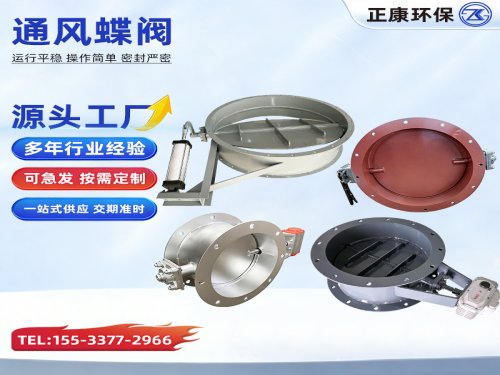
Ventilation Butterfly Valve Working Principle and Common Faults
文章摘要:
I. Working Principle The core of the ventilation butterfly valve is that the disc-shaped butterfly plate rotates within the valve body around the valve axis from 0° to 90° to achieve the on-off and regulation of the air
I. Working Principle
The core of the ventilation butterfly valve is that the disc-shaped butterfly plate rotates within the valve body around the valve axis from 0° to 90° to achieve the on-off and regulation of the airflow.
Fully open (90°): The butterfly plate is parallel to the airflow, with the minimum resistance and the airflow flowing directly.
Adjustment (0° - 90°): The butterfly plate forms an angle with the airflow, changing the flow area and precisely regulating the air volume / air pressure.
Fully closed (0°): The butterfly plate is perpendicular to the airflow, tightly sealing the cover, and blocking the airflow (the standard type is non-sealed, with a higher leakage rate than the dedicated cut-off valve).
The driving method can be manual, electric, or pneumatic. Electric / pneumatic can be remotely controlled and automatically adjusted.
II. Common Faults and Troubleshooting
1. Stuck in opening / closing / inability to fully open / close
Symptom: The operation is strenuous, with stalling, or unable to fully open / close.
Reasons: ① Dust / welding slag gets stuck in the gap between the butterfly plate and the valve body; ② The valve stem is bent, the bearing is rusted; ③ Pipeline stress causes the valve body to deform; ④ Long-term static sealing surface adhesion.
Treatment: ① Disassemble and clean to remove debris; ② Correct or replace the valve stem, and rust-remove and lubricate the bearing; ③ Re-align and install, add brackets to reduce stress; ④ Regularly manually rotate the valve to prevent adhesion.
2. Sealing leakage (internal leakage / external leakage)
Symptom: There is still air after closing, or leakage at the valve body / shaft end.
Reasons: ① The sealing ring is aged, cracked or worn; ② The butterfly plate is not tightly pressed (limit not accurate, insufficient torque); ③ The sealing surface is scratched / corroded by particles; ④ The valve stem is offset, causing eccentricity of the butterfly plate.
Treatment: ① Replace with a temperature-resistant / corrosion-resistant sealing element (such as fluororubber); ② Calibrate the limit and torque of the actuator; ③ Grind and repair or replace the sealing surface; ④ Adjust the coaxiality of the valve stem.
3. Actuator failure (electric / pneumatic)
Symptom: The motor does not rotate, overheats and trips; the pneumatic does not act or has insufficient output.
Reasons: ① Power phase missing / voltage abnormal, motor overload and burns out; ② Insufficient air pressure (standard 0.4 - 0.7 MPa), electromagnetic valve stuck; ③ Wear of transmission components, lubrication failure.
Treatment: ① Check the power supply, replace the motor, add overload protection; ② Adjust the air pressure, clean / replace the electromagnetic valve; ③ Inspect the transmission components, add lubricating grease.
4. Noise and vibration
Symptom: There is abnormal noise during operation, and pipeline vibration.
Reasons: ① Uneven dust accumulation on the butterfly plate / valve body; ② Loose fasteners; ③ High flow speed causes whistling; ④ Bearing wear.
Treatment: ① Clean; ② Tighten the bolts; ③ Adjust the opening degree to reduce the flow rate; ④ Replace the bearing.
III. Key Points of Preventive Maintenance
Regular cleaning: Check monthly, remove dust accumulation between the butterfly plate and the valve body.
Lubrication maintenance: Add high-temperature lubricating grease (such as molybdenum disulfide) to the valve stem and bearing every quarter.
Action test: When not in use for a long time, fully open / close once a month to prevent sticking.
Sealing inspection: Check the sealing ring every six months, replace the aging sealing ring in time.
